Overview
I lost 9.9lb over 7 weeks by switching my dinners to be mashed potatoes with cottage cheese!
My starting weight was 186.3lb, and my ending weight was 176.4lb.
(5ft 10in tall, 34 years old, male)
Background
Current research suggests that:
- Eating nothing but potatoes is an effective way to lose weight.
- Eating dairy with potatoes is slightly less effective than just eating potatoes.
- Eating meat with potatoes seems to hamper the weight loss effect.
- Eating potatoes 50% of the time seems to result in only 26% the weight loss.
| Diet | Effectiveness | Percent body weight lost over 4 weeks | Weekly weight loss |
| 100% potatoes | 100% | 3.7% | 1.96lb |
| Potatoes + dairy | 84% | 3.1% | 1.51lb |
| Potatoes + meat | 54% | 2.0% | 1.12lb |
| Half-potato | 26% | 0.96% | 0.53lb |
Potatoes and cottage cheese for dinner
I thought it might be fun to try a diet of potatoes and cottage cheese.
Another might have felt fine eating potatoes and cottage cheese for every meal, but I tend to be on the hungrier side, and a single day of trying to eat potatoes and cottage cheese for both lunch and dinner convinced me that that wasn’t going to work. I immediately switched to eating a normal lunch and potatoes and cottage cheese just for dinner.
This meant that my daily protocol was:
- Wake up around 10:30AM
- Eat Panda Express for lunch, around noon
- Go for a ~15 minute walk
- Eat potatoes and cottage cheese for dinner
- Go for a 30-45+ minute walk
Lunch
I chose to have my lunches be Panda Express because it’s cheap and filling, and I think I tend to not gain weight from eating it.
After a couple of weeks of experimenting, I settled on eating the same thing at Panda Express each day:
- Sweet Fire chicken (2x)
- Broccoli Beef
- Super Greens (cooked broccoli, cabbage, and kale)
About twice per week, I would grab lunch with family and eat something totally different.
Dinner
Dinner was essentially the same every day:
- 6 large potatoes (a little over 2lb)
- 3/4 cup cottage cheese
Potatoes were sliced, boiled, and drained, then mashed together with cottage cheese and a generous amount of salt and pepper.
I used 2% reduced fat cottage cheese.
I generally didn’t peel the potatoes unless they were green.
Nutrition
Since I was eating the same thing each day, we should be able to get a pretty accurate picture of the nutrients that I was consuming. First, let’s look at the macronutrients:
| Nutrient | Amount | Percent of recommended daily value |
| Calories | 1,954 | 98% |
| Protein | 92g | 184% |
| Carbohydrates | 299g | 109% |
| Fiber | 31g | 110% |
| Total fat | 41g | 52% of upper limit |
| Saturated fat | 10g | 52% of upper limit |
| Sugar | 63g | – |
One of the main complaints with the original potato diet was that it didn’t provide enough protein, and I think this diet has solved that issue nicely. 92g of protein probably isn’t enough for a body builder, but I think it’s probably fine for an average person.
Next up are the micronutrients:
| Nutrient | Amount | Percent of recommended daily value |
| Vitamin K | 418mcg | 348% |
| Vitamin B6 | 5.6mg | 327% |
| Copper | 2.9mg | 320% |
| Pantothenic acid | 13mg | 267% |
| Vitamin C | 233mg | 258% |
| Niacin | 42mg | 262% |
| Selenium | 116mcg | 211% |
| Manganese | 4.7mg | 206% |
| Riboflavin (B2) | 2.4mg | 188% |
| Thiamin | 1.7mg | 141% |
| Potassium | 6,624mg | 141% |
| Phosphorous | 1,501mg | 120% |
| Sodium | 2,636mg | 115% of upper limit |
| Vitamin B12 | 2.6mcg | 110% |
| Zinc | 12mg | 109% |
| Magnesium | 426mg | 101% |
| Folate | 348mcg | 87% |
| Iron | 14.5mg | 81% |
| Choline | 433mg | 79% |
| Calcium | 656mg | 50% |
| Vitamin A | 386mcg | 43% |
| Vitamin E | 3.2mg | 22% |
That’s a lot of Vitamin K, Vitamin B6, Copper, Niacin, Pantothenic acid, Vitamin C, and Manganese!
Sources:
- Potatoes (90% boiled potatoes, 10% boiled potato skin)
- Cottage cheese
- Panda Express macronutrients
- Panda Express micronutrient estimates:
- Super Greens (40% broccoli, 30% kale, 30% cabbage)
- Sweet Fire Chicken (55% chicken breast, 20% pineapple, 10% red bell pepper [didn’t eat], 5% onion [didn’t eat],10% sauce)
- Broccoli Beef (55% top-sirloin, 35% broccoli, 10% sauce).
- Coffee
- Regular salt (3/16tsp, estimated)
- Morton lite salt (3/16tsp, estimated)
Notes:
- I separately estimated micronutrients for the Panda Express items, because their official nutrition information only contained macronutrients.
- During the diet, I sometimes used salt that was perhaps 25% potassium, but this only increased my daily consumption of potassium by 4%.
Intestinal discomfort
Several times during the diet, I had awful, burning stools for multiple days. At the time, I thought this might have been caused by eating too much spicy food, not peeling green potatoes well enough, or add adding too much salt or pepper to the potatoes. In retrospect, it might also have been from eating cottage cheese every day as a person who is somewhat lactose intolerant.
Results
As I discussed in a previous article, people tend to lose an abnormally high amount of weight during the first week of a diet, and it appears that this holds true for the “potatoes and cottage cheese for dinner” diet, as well:
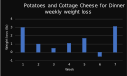
To compensate for this, we drop the first week of data and then find the average weekly weight loss, which is 1.15lb.
We can now fairly compare the diet with the other potato diets, which have already been normalized in like manner:
| Diet | Effectiveness | Percent body weight lost over 4 weeks | Weekly weight loss |
| 100% potatoes | 100% | 3.7% | 1.96lb |
| Potatoes + dairy | 84% | 3.1% | 1.51lb |
| Potatoes + cottage cheese for dinner | 68% | 2.5% | 1.15lb |
| Potatoes + meat | 54% | 2.0% | 1.12lb |
| Half-potato | 26% | 0.96% | 0.53lb |
Surprisingly, eating potatoes and dairy for one meal a day seems to be about 80% as effective as eating potatoes and dairy for every meal!
Also surprisingly, I seem to have lost far more weight eating potatoes and cottage cheese for dinner than people did during Slime Mold Time Mold’s half-potato diet experiments. This seems strange, because “potatoes and cottage cheese for dinner” is a half-potato diet.
What’s going on? I don’t know, but looking at the core characteristics of the diet might provide some ideas for why it was so effective.
Uniqueness
Defining characteristics of the “potatoes and cottage cheese for dinner” diet:
- Almost half (40%) of daily calories were from potatoes.
- Potatoes were eaten as a separate meal.
- Potatoes were prepared by boiling, draining, and then mashing them. Perhaps the preparation method matters?
- Relatively high in protein: (92g a day, or 0.5g per pound of body weight)
- Rich in certain nutrients:
- More than 100% recommended daily value of Selenium, Riboflavin (B2), Potassium, Thiamin, Phosphorous, and Sodium.
- More than 200% recommended daily value of Vitamin K, Copper, Vitamin B6, Niacin, Vitamin C, Pantothenic acid, and Manganese.
- I generally ate Panda Express for lunch (super greens, broccoli beef, and 2x sweet fire chicken), and on days where I ate something else for lunch, I felt like I tended to lose less weight. Perhaps eating a lunch of Panda Express is an important component of this diet! :)
- I drank about 40oz black coffee per day (no sugar or cream).
Future work
“Potatoes and cottage cheese for dinner” seems to be very effective, but the reason why remains a mystery. Perhaps the diet is just particularly well suited for me. Perhaps boiling, draining, and mashing potatoes is an ideal way to prepare them. Perhaps drinking more black coffee leads to more weight loss. Or perhaps Panda Express really is the amazing lunch that we’d like it to be.
I hope that people take inspiration from this diet and try to reproduce it, in part or in whole! If you do, please consider writing up your results — I’d be happy to post them on this blog! :) Or if writing up your results is too much work, please consider tracking your weight in a spreadsheet and emailing it to me so I can do some analysis ([email protected]). If you’re on X, feel free to tag me and use the hashtag #potatodiet.
Thanks
Thanks to Slime Mold Time Mold for sparking my interest in the potato diet, and thanks to Will_Of_Europa, exfatloss, and Slime Mold Time Mold for their encouragements on X! :) And praise be to God, through Jesus his son!
Until next time! ^_^